AI for HR
The 5 Levels of AI Evolution in HR
From writing assistant to digital teammate: how AI can help HR teams work faster, smarter, and at greater scale.
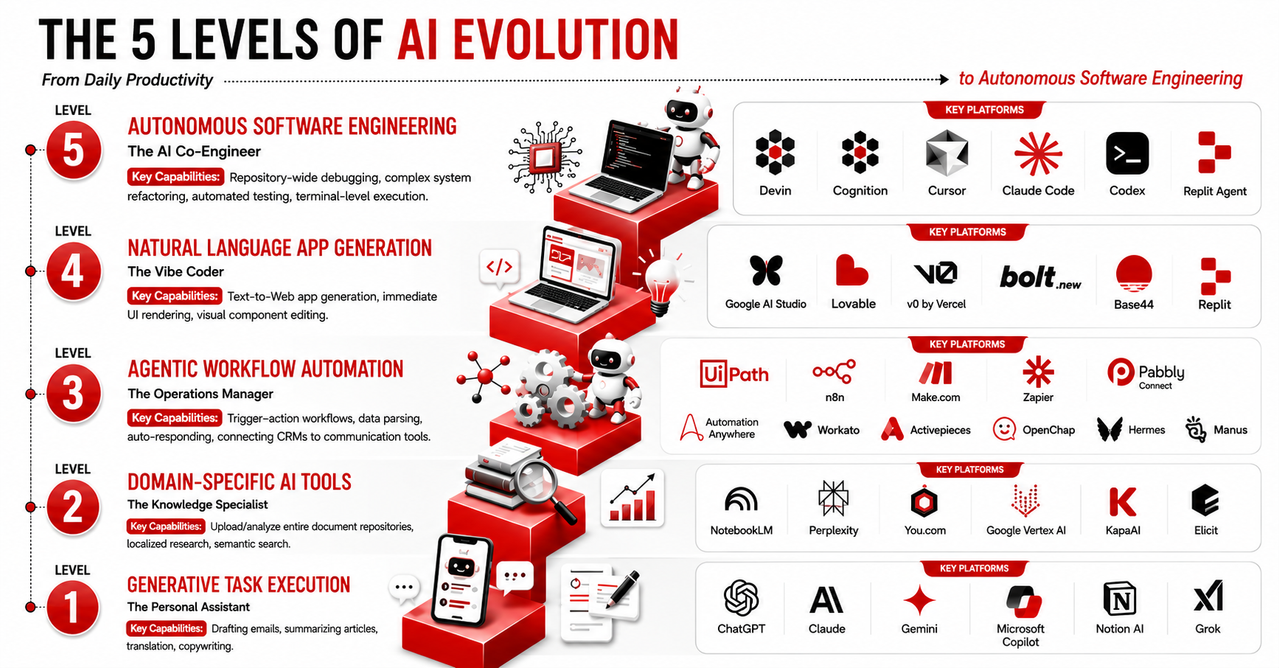
Over the past year, I have been actively experimenting with AI across HR Analytics, Workforce Planning, HR Reporting, and HR Transformation. One thing has become increasingly clear: AI is no longer just a productivity tool. It is becoming a digital teammate that can help HR teams operate faster, smarter, and at greater scale.
Level 1 is Generative Task Execution: using AI as a personal assistant. This includes drafting announcements, summarizing meetings, creating presentations, translating content, and refining business communication. Tools such as ChatGPT, Claude, Gemini, and Copilot are useful when HR needs speed and quality in everyday communication work.
Level 2 is Domain-Specific AI: using AI with specialized HR knowledge. This includes analyzing employee survey results, reviewing exit interview feedback, building searchable HR knowledge repositories, and conducting research or benchmarking. Tools such as NotebookLM, Perplexity, and Vertex AI help HR teams work with knowledge in a more structured way.
Level 3 is Agentic Workflow Automation: using AI to automate HR processes. Candidate screening workflows, automated HR reporting, HRIS-to-dashboard data pipelines, and automated notifications or approvals all belong here. Tools such as n8n, Make, Zapier, Manus, and Hermes mark the shift from AI helping me work to AI working alongside me.
Level 4 is Natural Language App Generation: using AI to build HR applications without traditional development cycles. Workforce planning apps, HR analytics dashboards, career path simulators, and internal HR service portals can now move from idea to prototype within hours. Tools such as Google AI Studio, Lovable, v0, and Bolt make experimentation much faster.
Level 5 is Autonomous Software Engineering: using AI as a development partner. This includes writing and reviewing code, debugging applications, building data solutions, and accelerating prototype development. Tools such as Claude Code, Codex, Cursor, and Devin can help HR professionals who understand the business problem test solutions much faster.
For HR professionals, the future is not about everyone becoming a programmer. It is about understanding which problems AI can solve, how to redesign workflows around AI, and how to combine Business, Data, and AI to create measurable impact.
The most valuable HR professionals in the next 3-5 years may not be those who know the most HR practices alone. They may be those who can effectively orchestrate people, data, and AI together.