
AI Business
AI Business Enablement Framework
Turning AI from a "Tool" into "Business Impact"
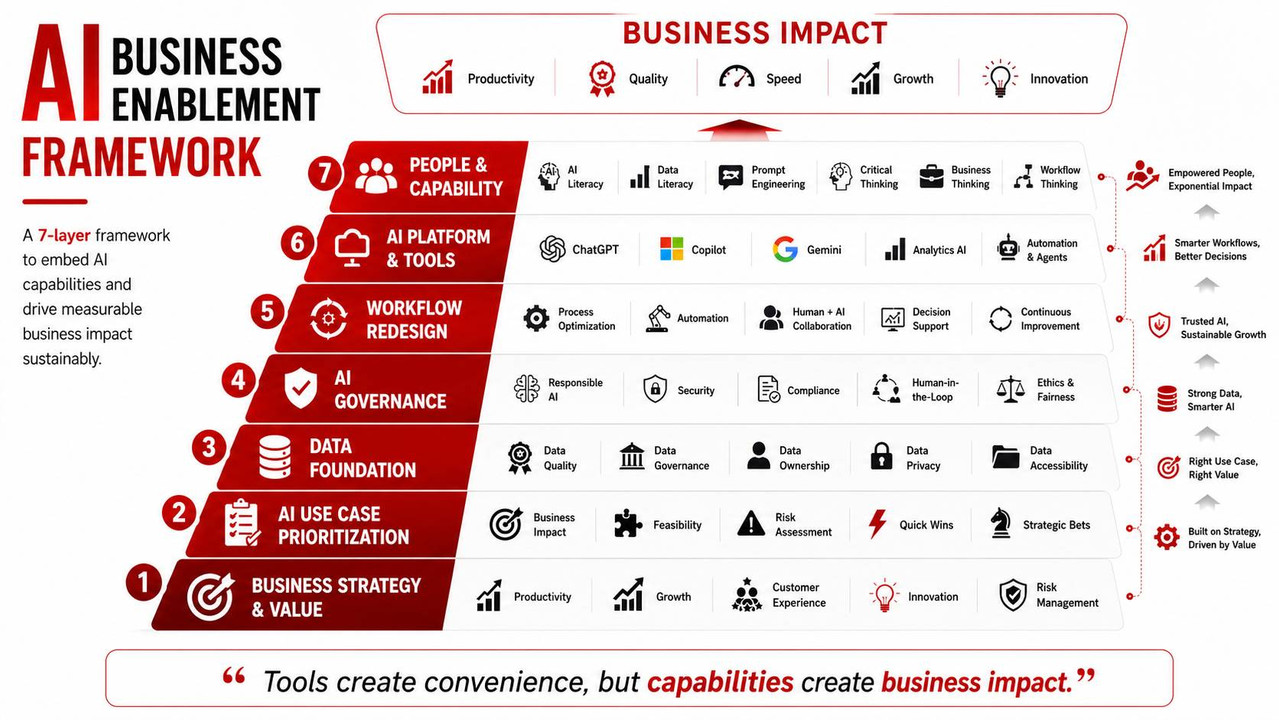
Over the past two years, many organizations have invested heavily in AI—whether it's ChatGPT, Copilot, Gemini, or various AI platforms.
But the crucial question is:
Why do some organizations see clear business results from AI,
while others remain stuck in the "pilot" phase?
The answer isn't in choosing the best tool.
It lies in building an Ecosystem that allows AI to create genuine business value.
I call this concept:
AI Business Enablement Framework
A framework that helps organizations transition AI from simple Technology Adoption to measurable Business Impact.
Business Impact is the goal, not AI
Many organizations start with the question:
"What AI should we use?"
But the right question should be:
"What business outcome are we trying to achieve?"
AI is not the goal.
AI is merely a tool.
The true goals are:
- Productivity
- Quality
- Speed
- Growth
- Innovation
Therefore, every AI investment should always begin with Business Strategy.
Layer 1: Business Strategy & Value
Start with business value
Before talking about AI, organizations must be able to answer:
What value will AI bring to our business?
Key objectives most organizations strive for:
- Productivity — Increasing operational efficiency.
- Growth — Driving business expansion.
- Customer Experience — Elevating the customer journey.
- Innovation — Creating new products, services, and business models.
- Risk Management — Reducing operational risks.
If you cannot clearly link AI to business value,
your AI investment may end up being just another technology expense.
Layer 2: AI Use Case Prioritization
Choose the "right" Use Case before investing
One of the most common problems is:
Organizations have too many AI ideas,
but no criteria for deciding where to start.
A good Use Case should be evaluated across 5 key dimensions:
1. Business Impact
How much business value does it generate?
2. Feasibility
Is it actually achievable?
3. Risk Assessment
What are the potential risks?
4. Quick Wins
Can it generate results quickly?
5. Strategic Bets
Does it help build long-term competitive advantage?
Successful organizations usually start with Quick Wins,
then scale toward Strategic AI Initiatives.
Layer 3: Data Foundation
Without good data, there is no good AI
One sentence remains true regardless of the era:
"Garbage In, Garbage Out"
The effectiveness of AI depends entirely on the quality of the data it receives.
Therefore, organizations must invest in:
- Data Quality
- Data Governance
- Data Ownership
- Data Privacy
- Data Accessibility
What leaders should realize:
AI cannot fix poor-quality data.
Conversely:
AI may amplify the impact of incorrect data.
Data Foundation is the most critical pillar of AI Transformation.
Layer 4: AI Governance
Use AI responsibly
Adopting AI isn't just about efficiency.
It also involves:
- Security
- Transparency
- Fairness
- Trustworthiness
Key components of AI Governance:
- Responsible AI
- Security
- Compliance
- Human-in-the-Loop
- Ethics & Fairness
The goal is not just to use AI,
but to use it safely and reliably.
Layer 5: Workflow Redesign
AI won't create results if you keep using the same old processes
Many organizations insert AI into existing workflows.
The result?
Doing the same thing, just a little bit faster.
Organizations that truly see results do more than that.
They redesign their entire workflows by integrating:
- Process Optimization
- Automation
- Human + AI Collaboration
- Decision Support
- Continuous Improvement
Key Principle:
The most powerful AI
isn't the smartest one,
it's the one embedded into the organization's workflow.
Layer 6: AI Platform & Tools
Tools are just one part of the equation
Organizations currently have many choices:
- ChatGPT
- Microsoft Copilot
- Google Gemini
- Analytics AI
- Automation Platforms
- AI Agents
However:
Having the best tools
does not mean you will achieve the best results.
It's like saying:
Buying a Formula 1 car
doesn't make everyone a Formula 1 driver.
Technology Follows Strategy
Technology should support the strategy,
not dictate it.
Layer 7: People & Capability
The most important factor for success
Even if an organization has:
- Good Data
- Strong Governance
- Modern Platforms
If the people in the organization cannot use AI effectively,
the entire investment may not yield the expected results.
6 essential skills organizations must develop:
AI Literacy
Understanding how AI works and its limitations.
Data Literacy
Reading, analyzing, and using data correctly.
Prompt Engineering
Communicating with AI effectively.
Critical Thinking
Verifying, analyzing, and questioning AI-generated outputs.
Business Thinking
Connecting AI to business goals.
Workflow Thinking
Identifying opportunities to improve work processes.
The AI race
may not be about technology,
but about the capability of the people.
From AI Adoption to AI Transformation
Many organizations still measure success by:
- Number of Licenses
- Number of Users
- Number of Prompts
But the true KPIs should be:
Business Outcomes
- Has productivity increased?
- Has work quality improved?
- Has operational speed increased?
- Has the business grown?
- Have new innovations emerged?
Successful AI
isn't the one that is used the most,
but the one that generates real business impact.
Key Takeaways
Organizations that win in the AI era
aren't necessarily the ones with the best tools,
but the ones that can connect:
Business Strategy
Data
Governance
Workflow
Technology
People
systematically,
and turn AI into sustainable Business Impact.
"Tools create convenience, but capabilities create business impact."